
 Tweet
Tweet
I have been curious about the state of the Atlantic Croaker fishery. I’m 44 and I remember the tail end of the ‘great croaker era’ of the 60s and 70s fishing off Witt’s Pier in Corpus with my Grandad. They were good tasting and plentiful - great times.
According to reports I read online, the number and size of croaker were adversely affected first and foremost by bay shrimping (bycatch) and secondly by their use as a bait fish.
I asked TPWD for data that outlines the state of the fishery and if the shrimp license buyback program has yielded improvement in the population. TPWD were incredibly responsive with the information I’ll share with you below. Thanks in particular to Mark Fisher at the Rockport Marine Lab for answering my gillion questions.
From TPWD e/mails received from Mark Fisher (shared here with his permission):
The Atlantic croaker population has been increasing in numbers, according to [the TPWD] bay and Gulf trawl surveys. We take a total 1,680 trawl samples from nine bay systems and 960 trawl samples from five Gulf areas every year, and record the number and size of each organism caught.
Our bay trawl survey indicates a variable but growing number of Atlantic croaker:
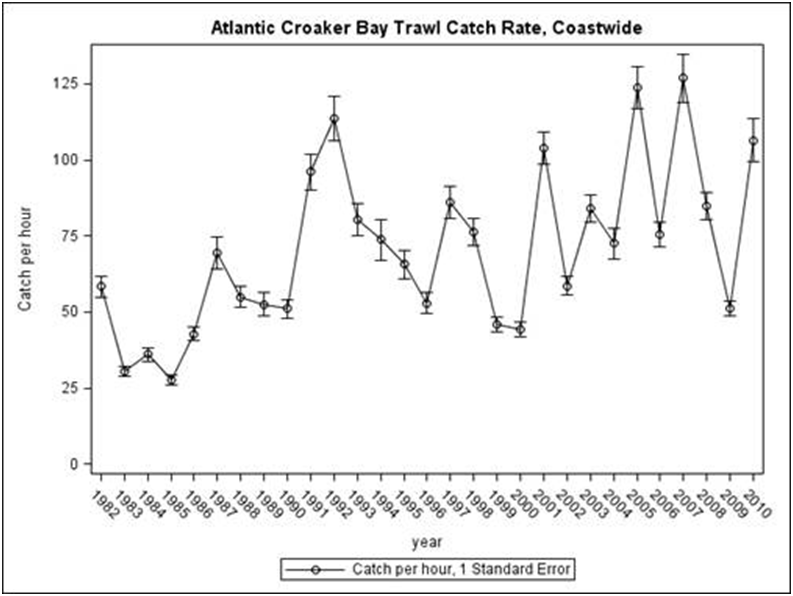
Our Gulf trawl survey indicates a dramatic increase, with the past few years being at or near-record highs.
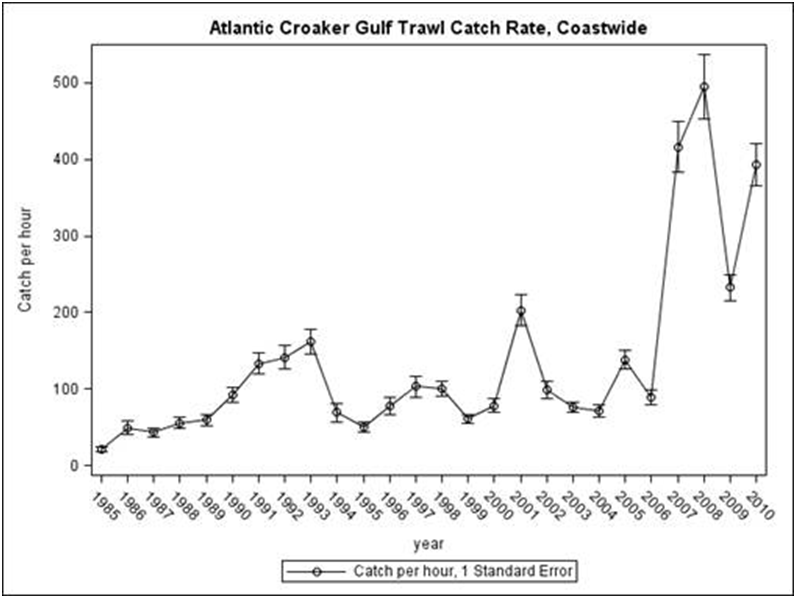
These increases are due to the reduction in commercial shrimping, which catch croaker as bycatch. Our creel surveys indicate anglers are catching more croaker, particularly in Sabine Lake and Galveston Bay during the fall.
After receiving Mark’s original e/mail, I sent him some additional questions which he was kind enough to answer (answers shown in italics).
1. Do you have any statistics on croaker size in the trawl catch studies. Other reports/papers I have read indicate that many of the bycatch croaker were 1” to 2” juveniles and that few ‘mature’ croaker existed in the inland waters due to bay shrimping. Can you tell from the trawl catch how many croaker are reaching maturity?
Croaker are fall spawners, typically October,, and the young-of-the-year first appear in trawls in late February-early March:
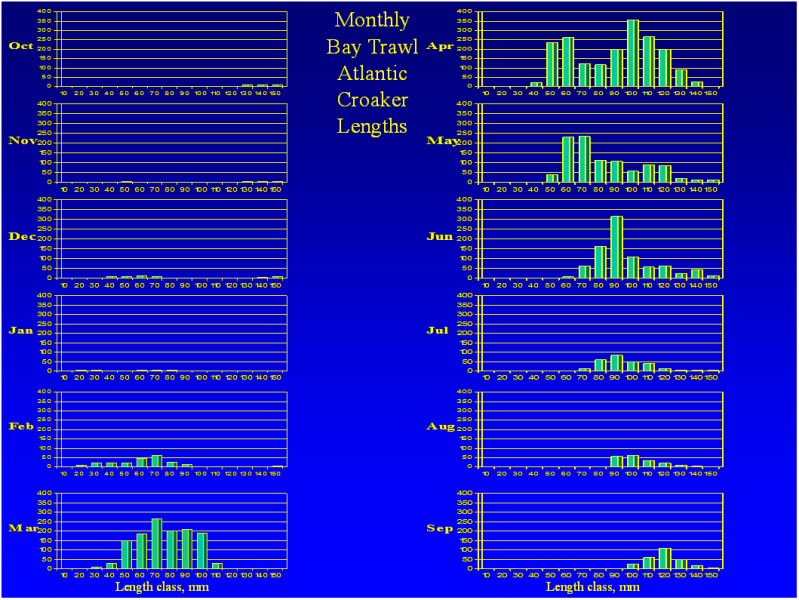
They grow rapidly, and become large enough to evade capture by trawls by July. This is why croaker are only available as bait from March to June, and because of this some erroneously believe that the croaker are “all gone”. Croaker that are age-1 and older aren’t caught by trawls (they live up to 5 years and reach maturity at age 1, around 140-170 mm). Instead, we see the older, mature fish in our gill nets and our creel survey.
2. What causes the year over year statistical variation in catch rate (i.e. what happened in 2009)? The trend is upward but the year over year change is staggering.
These trawl-caught fish are only a few months old, and recruitment of these young fish is highly variable. The entire population is not represented in trawls.
3. I read a 2000 study that estimated the number of croaker lost to buy catch and the number used by inshore fisherman. Do you have any update to those statistics?
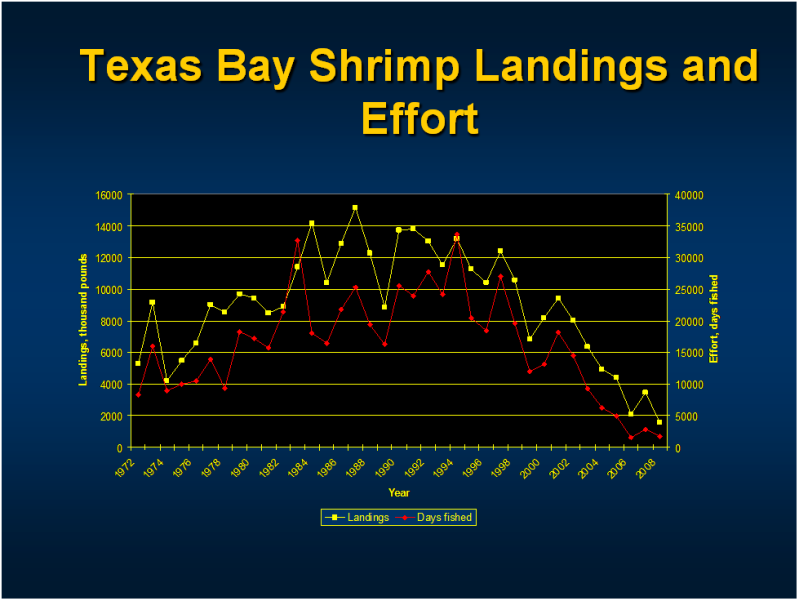
Commercial shrimping effort is so low now that bycatch is no longer an issue:
 Bait
Bait
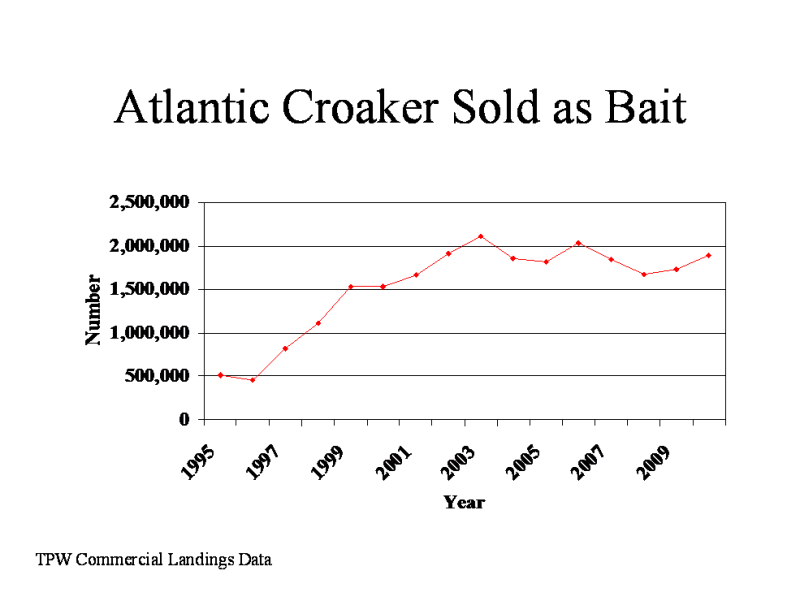
use by anglers escalated from 1995-2003, then has declined slightly. At $10-$14 per dozen, most anglers won’t use them.
4. Do you have any studies that link the use of croaker as bait to speckled trout catch? I have heard a number of fisherman represent that croaker are used to adversely focus on large trout and therefore limit the breeding or sow stock.
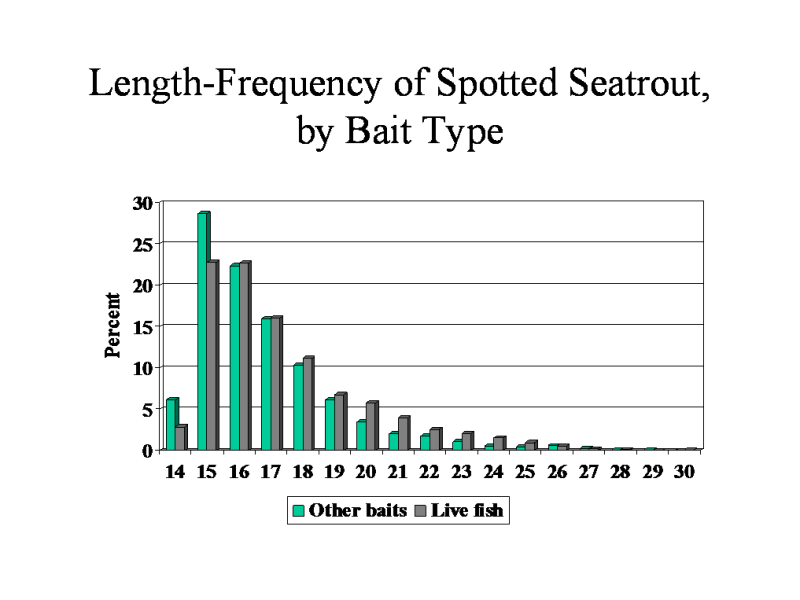
The use of live fish as bait (mostly croaker, but also pinfish and pigfish) does have a slight advantage over other baits on larger trout, but there is no overfishing occurring on trout as a result. More trout are caught using live shrimp than any other bait.
I hope you enjoy the data. I thought it was interesting and really appreciate the support I got from TPWD answering my questions.
JYC
According to reports I read online, the number and size of croaker were adversely affected first and foremost by bay shrimping (bycatch) and secondly by their use as a bait fish.
I asked TPWD for data that outlines the state of the fishery and if the shrimp license buyback program has yielded improvement in the population. TPWD were incredibly responsive with the information I’ll share with you below. Thanks in particular to Mark Fisher at the Rockport Marine Lab for answering my gillion questions.
From TPWD e/mails received from Mark Fisher (shared here with his permission):
The Atlantic croaker population has been increasing in numbers, according to [the TPWD] bay and Gulf trawl surveys. We take a total 1,680 trawl samples from nine bay systems and 960 trawl samples from five Gulf areas every year, and record the number and size of each organism caught.
Our bay trawl survey indicates a variable but growing number of Atlantic croaker:
Our Gulf trawl survey indicates a dramatic increase, with the past few years being at or near-record highs.
These increases are due to the reduction in commercial shrimping, which catch croaker as bycatch. Our creel surveys indicate anglers are catching more croaker, particularly in Sabine Lake and Galveston Bay during the fall.
After receiving Mark’s original e/mail, I sent him some additional questions which he was kind enough to answer (answers shown in italics).
1. Do you have any statistics on croaker size in the trawl catch studies. Other reports/papers I have read indicate that many of the bycatch croaker were 1” to 2” juveniles and that few ‘mature’ croaker existed in the inland waters due to bay shrimping. Can you tell from the trawl catch how many croaker are reaching maturity?
Croaker are fall spawners, typically October,, and the young-of-the-year first appear in trawls in late February-early March:
They grow rapidly, and become large enough to evade capture by trawls by July. This is why croaker are only available as bait from March to June, and because of this some erroneously believe that the croaker are “all gone”. Croaker that are age-1 and older aren’t caught by trawls (they live up to 5 years and reach maturity at age 1, around 140-170 mm). Instead, we see the older, mature fish in our gill nets and our creel survey.
2. What causes the year over year statistical variation in catch rate (i.e. what happened in 2009)? The trend is upward but the year over year change is staggering.
These trawl-caught fish are only a few months old, and recruitment of these young fish is highly variable. The entire population is not represented in trawls.
3. I read a 2000 study that estimated the number of croaker lost to buy catch and the number used by inshore fisherman. Do you have any update to those statistics?
Commercial shrimping effort is so low now that bycatch is no longer an issue:
Bait use by anglers escalated from 1995-2003, then has declined slightly. At $10-$14 per dozen, most anglers won’t use them.
4. Do you have any studies that link the use of croaker as bait to speckled trout catch? I have heard a number of fisherman represent that croaker are used to adversely focus on large trout and therefore limit the breeding or sow stock.
The use of live fish as bait (mostly croaker, but also pinfish and pigfish) does have a slight advantage over other baits on larger trout, but there is no overfishing occurring on trout as a result. More trout are caught using live shrimp than any other bait.
I hope you enjoy the data. I thought it was interesting and really appreciate the support I got from TPWD answering my questions.
JYC


 COMMUNITY WITH A LARGE
 PROBLEM AND A
  PROBLEM.


Comment